Quickie Clockit
Offline-first attendance and payroll management for farms, factories, and businesses.
Type
Tech stack
Connected services
Documentation
Full
Setup, architecture, and how the pieces fit together.
Maintenance
None
Sold as-is. No further updates from the Builder.
Description
What it does
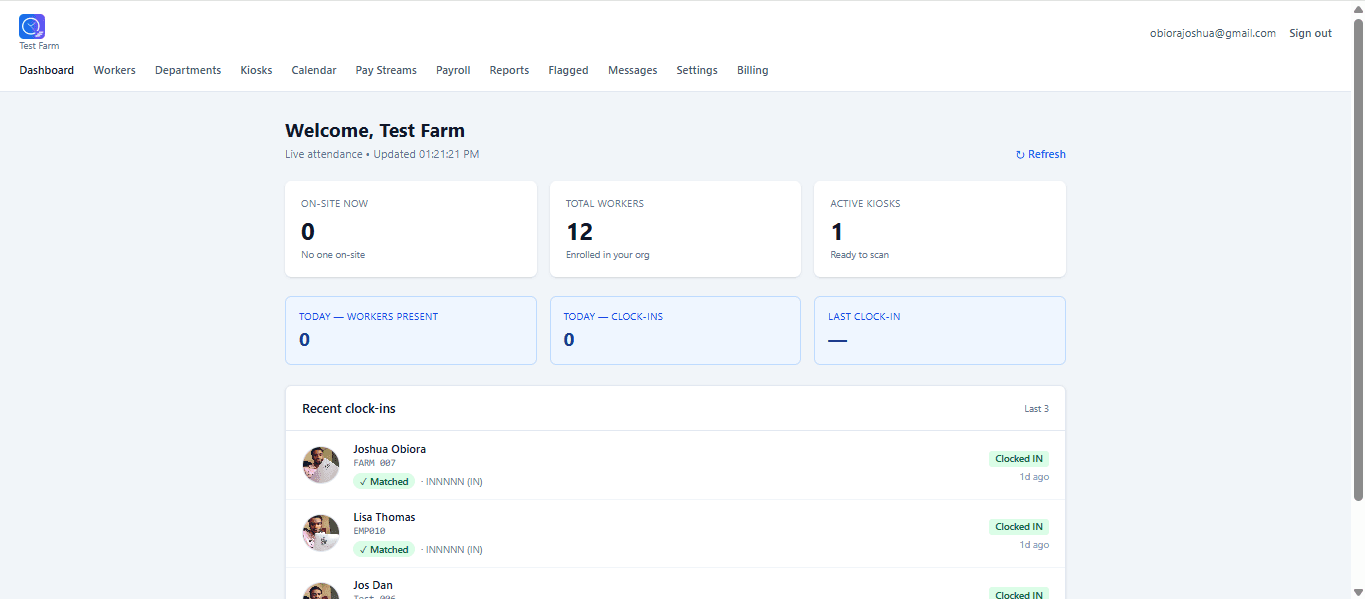
Quickie ClockIt is a complete workforce management SaaS for small-to-medium businesses, built for markets where internet is unreliable and payroll is still manual. Workers clock in with a QR badge or face verification at an offline-capable kiosk. Admins manage workers, departments, shifts, and payroll from a web dashboard.
Core features:
- Offline-first kiosk — QR scanning and face recognition work without internet. Clock-in events queue locally and sync when the connection returns.
- Payroll engine — hourly rates, daily multipliers (0.0–5.0), overtime, weekend/holiday rules, bonuses, and a
compute_payrollSQL function. - Department management — assign workers, bulk-move between departments, department-level multiplier overrides.
- Face recognition (V2) — biometric enrollment with explicit consent tracking. NDPR-compliant. Face data is stored as mathematical vectors, never as images.
- Multi-tenant — organizations, roles (owner / admin / viewer), and Row Level Security enforcing data isolation at the database layer.
- Billing — Paystack integration with V1/V2 subscription tiers, webhook-driven entitlement updates.
- Legal pages — Terms, Privacy, Cookie Policy, Help, About, Status, all built in.
How it's built
- Frontend: React 18 + TypeScript + Vite + Tailwind CSS
- Backend: Supabase (PostgreSQL, Auth, Row Level Security, Storage)
- Payments: Paystack (Nigeria-focused, live mode ready)
- Face recognition: face-api.js — browser-based, no external API calls, no biometric data leaves the device except the embedding
- Deployment: Vercel (frontend) + Supabase (backend)
- Security: CSP, X-Frame-Options, Referrer-Policy, Permissions-Policy configured in
vercel.json
What's included
- Full source code for the admin dashboard and the kiosk
- SQL migrations for every table, RLS policy, and the
compute_payrollfunction .env.examplewith setup instructions- Vercel configuration with security headers
- Legal page templates (Terms, Privacy, Cookie Policy, Help, About, Status)
- A
README.mdcovering prerequisites, install, env vars, database migration, and first login
Setup requirements
You need: Node.js 18+, a Supabase project (the free tier is sufficient), a Paystack account (optional — only needed for billing), and a Vercel account for deployment. A developer familiar with React and Supabase can have it running locally in 30–60 minutes.
Limitations (honest disclosure)
- Face recognition is V2-tier only; V1 uses QR-only clock-in.
- Paystack is Nigeria-focused. International payment providers would need a separate integration.
- There is no native mobile app. The kiosk runs in a mobile browser.
- Demo data is not included — you start with a clean database.
- Face recognition requires HTTPS and camera permissions. The kiosk falls back to QR-only if face features are disabled.
Who it's for
Businesses with 10–500 workers in farms, factories, schools, security firms, and hospitality — anywhere that needs proof of attendance and a payroll calculation that respects overtime and weekend rules. It is not a generic HR suite. It does one thing well: attendance in, payroll out.
Related Software
Domains
Seller

Reviews
No reviews yet.
Related reading
A breakdown of what an online store for the Egyptian market actually needs, and where starting from a finished build saves you a quarter.